In the concrete arcades of the Dezerter Bazaar near Tbilisi Central Station, the air in November carries a sharp, dry perfume. Pyramids of rust-colored spices sit in enamel basins alongside burlap sacks of newly shelled walnuts from Kakheti. Most travelers pass by these stalls assuming that the green-gold powders sold in small plastic cups are uniform blends, churned out by commercial mills. In truth, pre-mixed khmeli suneli from industrial packets is often stale, muted by high heat processing, and bulked out with cheap dried celery tops. The real blend, assembled in homes across western and eastern Georgia, is a finely tuned composition of botanical parts: dried flowers, seeds, and wild aromatic greens that demand whole processing.
Khmeli suneli translates literally to "dried spice." It is not an arbitrary seasoning salt, but the structural core of the country's cold table and slow-simmered stews. When you build the mixture from whole botanicals in your own kitchen, you control the balance between the resinous musk of dried marigold, the sweet grass notes of blue fenugreek, and the sharp citrus edge of coriander. To achieve the correct texture and aroma, you must procure the authentic plants, temper them with minimal heat, and mill them by hand to a specific, granular grit that can dissolve into cold nut emulsions without turning to sludge.
Sourcing true blue fenugreek and marigold flowers
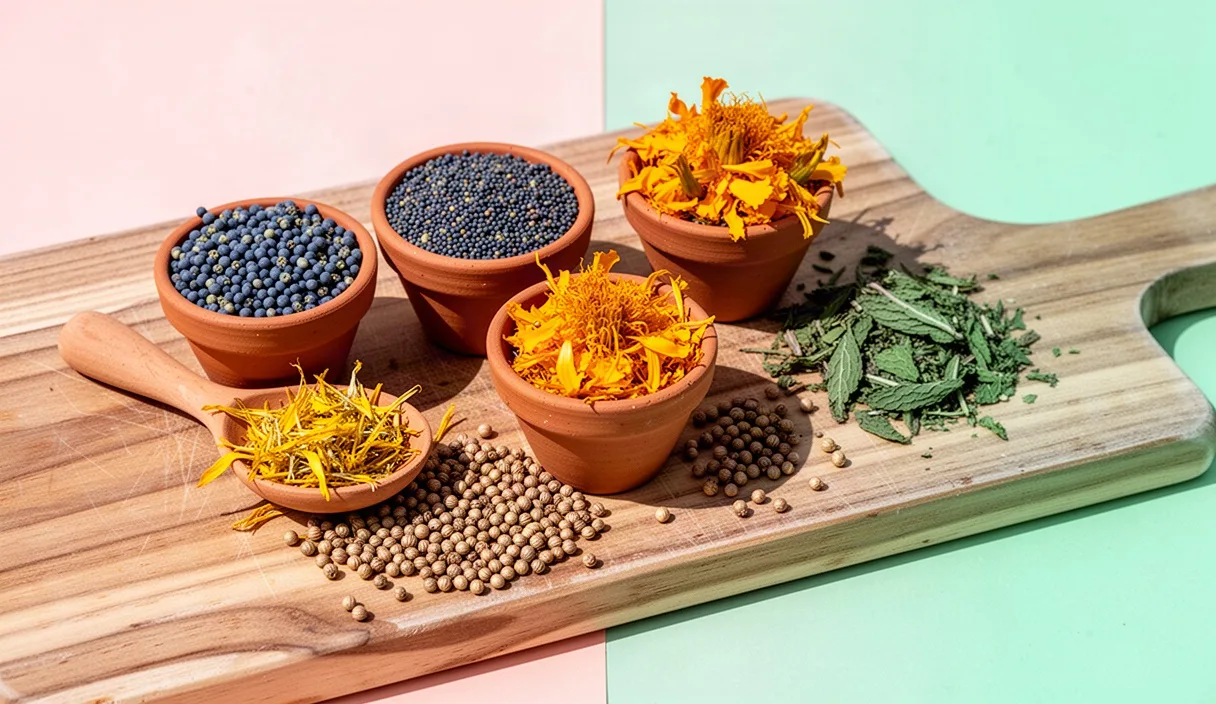
The defining soul of genuine khmeli suneli rests on two botanicals that are routinely substituted in foreign kitchens, usually to the detriment of the dish: blue fenugreek and dried marigold petals. Standard amber fenugreek, known botanically as Trigonella foenum-graecum and common across Indian and Middle Eastern cooking, is aggressively bitter and heavy with maple-syrup aromas. If you grind standard fenugreek into a Georgian recipe, its sharp bitterness will overpower the delicate greens. The Caucasus demands blue fenugreek, or Trigonella caerulea, known locally as utskho suneli.
Blue fenugreek grows in mountain meadows and river valleys across Georgia and the Alps. Its seeds are smaller, harder, and lighter tan than standard fenugreek. When crushed, utskho suneli releases an aroma reminiscent of sweet mown hay, toasted hazelnuts, and wild chicory, without the acrid bite that characterizes its cousin. Look for seeds that have been harvested in the late summer; they should be dry, uniform in size, and free from gray mildew. If you buy from an eastern European grocer, ensure the package indicates Georgian provenance or specifies the botanical name.
The second essential ingredient is imeruli shaphrani, literally Imeretian saffron. This is not the dried red stigma of the crocus bulb. It is the dried petal rays of the common French marigold, Tagetes patula or Tagetes active vitality. True saffron produces an iodine-honey aroma and a brilliant neon-yellow water soluble dye; marigold flowers provide a deeper, musky, vegetal warmth and an earthy ochre tone that binds the green herbs visually and aromatically. The flowers must be dried whole away from direct sunlight to preserve their essential carotenoids, then stripped of their bitter green calyx bases before grinding.
| Botanical Element | Local Name | Primary Variety | Flavor Character |
|---|---|---|---|
| Blue Fenugreek | Utskho suneli | Trigonella caerulea | Sweet hay, raw hazelnut, dried grass |
| Imeretian Saffron | Imeruli shaphrani | Tagetes patula | Earthy musk, faint apple skin, dried tea |
| Summer Savory | Kondari | Satureja hortensis | Sharp thyme, peppery carvacrol, pine |
| Purple Basil | Rehani | Ocimum basilicum var. purpurascens | Clove, sweet anise, mild camphor |
If you grow your own marigolds for this purpose, collect the heads during dry midday heat in late summer. Pluck the petals from the central seed pods, spread them on unbleached butcher paper in a dark room with active air circulation, and let them support two weeks until they crumble like dry parchment under gentle thumb pressure.
The correct proportion of aromatic seeds to leafy herbs
Khmeli suneli is often treated as an open-ended pantry formula, but traditional Georgian preparations rely on clear internal geometry. The mix splits into three functional groups: dense oily seeds that carry structure, dried leafy greens that deliver volatile aromatics, and floral or pungent modifiers that add depth. If you tip the ratio too far toward leafy herbs, the blend becomes astringent like steeped tea; if you add too many seeds, it turns dense and pasty.
For a balanced kitchen batch of approximately 115 grams, work with dry weight rather than volume measurements. Leafy herbs vary dramatically in density depending on whether they are whole leaf, rub-sieved, or crushed, making measuring spoons unreliable.
- Coriander seed: 32 grams. This forms the citrus-wood anchor of the entire blend.
- Blue fenugreek seed: 24 grams. This provides the nutty, round baseline.
- Dried summer savory (kondari): 16 grams. This provides pepperiness and herbal warmth.
- Dried marigold petals (imeruli shaphrani): 14 grams. This yields color, floral depth, and vegetal sweetness.
- Dried purple basil (rehani): 11 grams. This brings aniseed undertones and balancing sweetness.
- Dill seed: 8 grams. Dill seed adds an earthy caraway-like bite that dry dill weed cannot supply.
- Dried mountain mint: 6 grams. A subtle cooling top note that cuts the richness of walnuts.
- Ground red adjika pepper or hot cayenne: 4 grams. Just enough capsaicin to spark the tongue without dominating.
Notice the intentional omission of heavy fillers like dried parsley or celery seed. While commercial Soviet-era factory blends often included dried parsley to cut costs, traditional western Georgian cooks avoid large amounts of leafy greens that oxidize into brown dust within weeks. The ratio of seeds to leafy herbs here sits at roughly 56 percent seed weight to 44 percent leaf and flower weight. This guarantees that when the mixture is pulverized, the natural oils from the coriander and dill seeds act as carrier liquids for the dry herbal aromatics.
Gentle pan warming without caramelizing seeds
Toasting spices in western culinary traditions usually means tossing seeds in a screaming-hot skillet until they pop, darken, and smoke. In Georgian spice craft, that approach ruins the product. Khmeli suneli relies on fresh, green, and floral volatiles: linalool from coriander, estragole from basil, and carvacrol from savory. High heat decomposes these compounds into harsh, bitter pyrazines that taste like burnt coffee.
The goal of pan warming is gentle dehydration and thermal expansion. You want to purge lingering moisture from the core of the seeds so they fracture cleanly in the mortar, while gently coaxing their essential oils toward the surface.
- Set a heavy cast iron or unglazed earthenware pan over the lowest possible burner flame. Allow the pan surface to stabilize at a temperature between 60 and 70 degrees Celsius. You should be able to hold your palm two inches above the metal without discomfort.
- Tip the whole coriander, blue fenugreek, and dill seeds into the dry pan. Keep them moving continuously with a wooden spoon or flat paddle. Do not let the seeds sit stationary on the hot metal.
- Warm the seeds for 90 to 140 seconds. Watch the color carefully: the blue fenugreek must not darken from its native grayish-tan hue, and the coriander should remain a light sandy straw.
- Smell the steam rising from the pan. The moment you catch a clear scent of warm orange peel and toasted wheat, immediately spill the seeds onto a broad, cold ceramic platter. Spreading them out stops the internal carryover cooking.
- Never heat the delicate leafy herbs or marigold petals in the pan. Direct heat shrivels the marigold's flavor into stale tobacco and destroys the purple basil. The leaves should enter the mortar cold and completely dry.
Mortar grinding for consistent coarse powder
Electric spice grinders and high-speed blenders run at thousands of revolutions per minute. Their spinning metal blades generate localized friction heat that oxidizes essential oils before they ever touch your food. Worse, electric blades shatter botanicals into an uneven mix of microscopic dust and large flaky shreds. For khmeli suneli, you want a uniform, medium-coarse grit, roughly comparable to coarse sea salt or dry cornmeal.
A heavy stone mortar made of rough granite, basalt, or marble is the correct tool. The coarse interior texture shears the botanicals rather than slicing them, crushing cell walls and pressing oils into the dry fibers.
Begin by placing the cooled seeds: coriander, blue fenugreek, and dill, into the bottom of the mortar bowl. Work with the pestle using downward driving blows rather than circular motions. The small, tough blue fenugreek seeds must be fractured first. Once the seeds crack open into gritty meal, switch to a firm, circular grinding stroke along the lower curve of the mortar wall.
Next, introduce the torn marigold petals. The rough seed grit acts as an abrasive, catching the soft petals and reducing them to tiny yellow flecks. Grind for two minutes until the mixture turns an even ochre-gold. Finally, add the dried summer savory, purple basil, and dried mint. These crumbly herbs require only a minute of moderate grinding to break down. Finish by stirring in the chili powder.
Pass the resulting mixture through a medium mesh wire sieve (roughly 400 microns or a standard 40-mesh kitchen strainer). Tap the rim lightly. The fine particles and soft herbal meal will fall through, leaving behind stubborn, uncrushed seed jackets and leaf ribs. Return those coarse remnants to the mortar, work them with the pestle for another sixty seconds, and sieve again. Discard any tiny, wood-like stems that refuse to break down. The finished powder should cling slightly to your fingers when pinched, held together by the cold seed oils.
Incorporating the blend into cold walnut satsivi pastes
The absolute proving ground for your freshly ground khmeli suneli is satsivi, the cold poultry dish served across Georgia on winter feast days, or its quick family table cousin, bazhe. In these dishes, the spice blend is not cooked into bubbling broths; it is emulsified cold directly into crushed walnuts.
Walnuts consist of roughly 65 percent fat by weight. When raw walnuts are crushed to a paste, their oils are exposed. Because the aromatic oils in coriander, summer savory, and blue fenugreek are primarily fat soluble, the walnut paste acts as an extraction medium. If you dump dry spices into boiling stock, their aromas flash off into the room. If you fold them into walnut fat, the flavor compounds bind to the lipids and linger on the palate.
Extracting spiced walnut oil
In traditional households from Samegrelo to Imereti, cooks extract pure, spiced walnut oil by hand to spoon over the finished cold dish. To do this, pound your walnuts through a fine meat grinder plate twice, or work them in the mortar with three cloves of garlic and a pinch of coarse sea salt until an oily paste forms. Add two teaspoons of your freshly ground khmeli suneli directly to 200 grams of walnut paste.
Knead the spiced paste vigorously in your palms or against the side of an earthenware bowl for several minutes. As the friction warms the walnut paste, the spices work into the cellular structure, and bright orange-tinted oil will begin to sweat out of the mass. Squeeze the paste firmly over a small cup to collect this clear, spiced walnut oil. Reserve it in the refrigerator to drizzle over the finished presentation plate.
Emulsifying the sauce
Once you have extracted the garnish oil, dilute the spiced walnut paste into the base sauce. Never use hot broth directly from the stockpot, as boiling liquid will cause the walnut emulsion to break, leaving greasy slicks on the surface. Allow your poultry stock or water to cool to room temperature.
Whisk the cool liquid into the spiced nut paste tablespoon by tablespoon. As the liquid integrates, add a splash of white wine vinegar or fresh, unfiltered pomegranate juice. The acidity activates the floral notes of the marigold and balances the rich weight of the blue fenugreek. The completed satsivi sauce should coat the back of a wooden spoon like heavy cream, showing tiny specks of purple basil and golden marigold throughout its ivory base.
Common mistakes
Avoiding a few frequent missteps will keep your batch clean, vibrant, and true to its regional origins.
- Substituting yellow fenugreek: Using common Indian fenugreek (methi) instead of blue fenugreek turns the entire mix bitter and imparts a heavy curry-house aroma that drowns the walnuts.
- Overheating the botanicals: Browning the seeds in a smoking pan oxidizes volatile linalool and produces scorched flavors that ruin cold dishes.
- Grinding leafy herbs into dust: Pulverizing summer savory and basil in an electric spice mill creates a powdery gray flour that turns sauces murky instead of clear and textured.
- Storing the blend in clear glass on open counters: Sunlight degrades the carotenoid pigments in dried marigolds within three weeks, bleaching the mixture to a dull ash color.
- Adding dry blend directly to boiling stews: Dumping raw khmeli suneli into a bubbling pot cooks away the top notes instantly; stir it into stews during the final five minutes of low simmering, or fold it into fats first.
Practical next steps
Once your mortar work is complete, pack the fresh khmeli suneli into an airtight, amber glass jar or a clean ceramic crock with a tight lid. Label it with the exact date of milling. Kept in a dark cupboard away from the steam of the cooktop, the whole-ground blend maintains its sharp aromatic integrity for four to five months. After six months, the leafy top notes will soften, though the seeds will continue to provide warmth to winter braises.
To test your batch immediately, prepare a quick pot of lobio kotanshi. Simmer red kidney beans with bay leaves and onions until tender, lightly mash them with a wooden pestle in a clay pot, and stir in one tablespoon of your fresh khmeli suneli, two crushed garlic cloves, fresh cilantro, and a splash of fermented red wine vinegar right as you take the pot off the fire. The residual warmth will bloom the fenugreek and marigold without cooking them, letting you evaluate the balance of your own hand-milled spice.