On damp autumn mornings in the Pidu district northwest of Chengdu, the air smells of turned soil, drying straw, and brine. Walking through the courtyards of traditional paste yards in Pixian, you pass thousands of glazed terracotta vessels standing row upon row on open gravel yards. Workers peel back conical bamboo hats before sunrise to expose broad beans and mashed chilies to the day heat, then stir them with wooden paddles before covering them against the night moisture. This process, known locally as drying by day and dewing by night, turns simple fava beans and Erjingtiao chilies into the dark, pungent backbone of Sichuan cooking.
For cooks outside Sichuan, doubanjiang often presents a puzzle. Shelves in Asian grocers in London, Vancouver, or Sydney carry red plastic tubs, vacuum bags, and heavy ceramic pots, all bearing the name Pixian Douban. Yet inside those containers lie radically different ingredients. Some pastes are glossy vermilion, watery, and packed with vegetable oil, while others look almost like wet peat, dark and dry. Knowing which paste to buy, how to read the packaging markings, and how to work it in an iron wok determines whether a mapo tofu or twice-cooked pork tastes flat and acrid or deep, savory, and rich with brick-red oil.
Reading production grades on Chinese earthenware jars
In China, Pixian doubanjiang holds geographical indication protection, which governs the bean varieties, water sources from the Min River basin, and microbial cultures used during production. The commercial grading system reflects the aging time in earthenware urns, which ranges from several months to five years. When you pick up a crock or carton, the mandatory national standard code GB/T 20560 confirms that the product originated in the certified production zone in Pidu, rather than being an industrial knockoff produced with accelerated thermal fermentation in a stainless steel tank.
The label will typically feature one of four formal grading tiers, usually printed alongside the manufacturer certification marks:
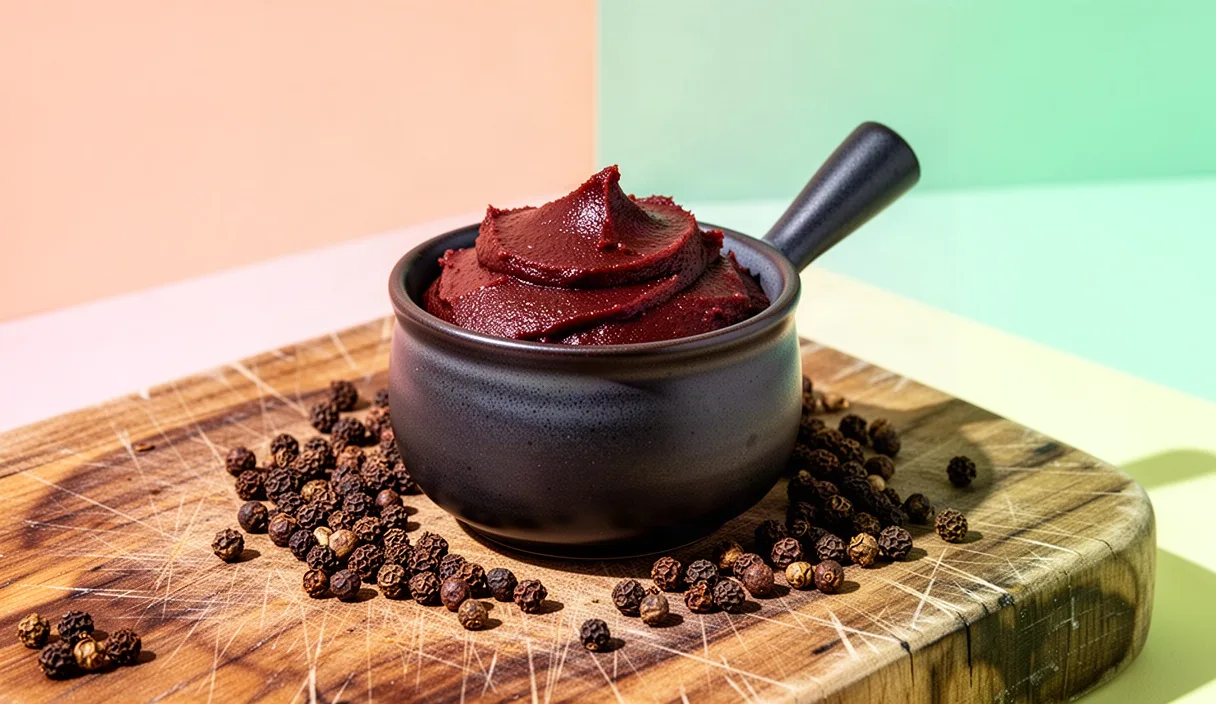
- Special Grade (Teji, 特级): Fermented for three full years or longer. The paste is mahogany to pitch-black, with low water content, minimal oil sheen, and an aroma reminiscent of dark soy sauce, dried porcini, and fermented cacao. It contains fragmented broad bean cotyledons that have absorbed the chili brine over several seasons.
- First Class (Yiji, 一级): Fermented for twelve to twenty-four months. The color sits squarely between russet and chestnut brown. It balances sharp chili fruitiness with savory umami and provides the most versatile base for everyday home cooking and stir-frying.
- Second Class (Erji, 二级): Fermented for six to twelve months. It appears reddish-brown with discernible pieces of pale broad bean and brighter chili skin. The aroma is sharper and more vegetal, with noticeable raw alcohol and lactic notes.
- Red Oil Douban (Hongyou Douban, 红油豆瓣): A blended commercial category aged for three to six months, cut with processed chili oil, and often stabilized with potassium sorbate. It is bright red, pourable, and visually vibrant, but lacks the fermented backbone of aged crock-matured pastes.
If you source paste packed directly into earthenware crocks sealed with wax and parchment, examine the ingredient declaration on the back label. Traditional aged doubanjiang requires only four basic components: fresh Erjingtiao chilies, broad beans, wheat flour, and non-iodized salt. The presence of soybean oil, monosodium glutamate, or disodium inosinate indicates an engineered sauce rather than a slow-fermented paste.
Assessing salinity across one-year and three-year ferments
Salt acts as the primary preservative during the long open-air fermentation cycle in Sichuan. In the hot, humid summer months of the Sichuan basin, salt concentrations must remain sufficiently high to inhibit putrefactive bacteria while allowing Aspergillus oryzae and salt-tolerant yeasts to break down the starches into amino acids. Consequently, both young and mature pastes carry substantial sodium loads, but their palate impact differs noticeably.
A one-year paste typically carries a salt level around 17% by weight. Because the proteins in the broad beans have had only twelve months to cleave into free glutamates, the salinity lands on the tongue with sharp, immediate intensity. The chilies still retain a measure of raw malic acidity, which makes the salt feel sharper. When cooking with a one-year paste, you must reduce or entirely omit additional light soy sauce and table salt from the wok, relying on the young doubanjiang to carry the sodium baseline of the dish.
By contrast, a three-year paste tests at a similar analytical salinity (roughly 15% to 18% salt by weight), yet it tastes considerably softer and rounder. The prolonged enzymatic action produces high volumes of amino acid nitrogen, complex esters, and organic acids. These compounds coat the tongue, mitigating the sharp sting of the sodium chloride. A three-year paste tastes deeply savory, earthy, and mineral rather than aggressively salty.
| Attribute | One-Year Ferment (Yiji) | Three-Year Ferment (Teji) |
|---|---|---|
| Visual Color | Rust red to light chestnut | Dark mahogany to charcoal black |
| Texture | Chunky, pliable, damp skins | Dense, paste-like, clay consistency |
| Chili Heat | Medium-high, sharp, forward | Mild to moderate, mellow warmth |
| Typical Sodium Level | 16% to 18% by weight | 14% to 17% by weight |
| Optimal Culinary Role | Color extraction, fast stir-fries | Braises, long stews, deep umami |
For dishes like Mapo Tofu, combining these two grades yields the cleanest balance. Using 70% one-year paste gives the sauce its signature red hue and direct chili spark, while adding 30% three-year paste supplies the earthy, grounding depth that prevents the sauce from tasting thin or abrasive.
Fine chopping to unlock natural carotenoids
Scooping doubanjiang straight from the jar into a hot wok is one of the most common errors in home cooking. Traditional Pixian paste consists of coarse segments of fermented chili skins and whole halved broad beans. The broad beans, after months of immersion, are firm and leathery. If left whole, they do not disperse into the sauce; they settle into the wok basin, stick to the metal, and burn before releasing their flavor.
More importantly, the primary pigment in Sichuan chilies is capsanthin, an oil-soluble carotenoid trapped inside the cellular matrix of the chili skins. To draw this brilliant scarlet pigment out into the cooking fat, the cell walls must be ruptured mechanically before the paste ever encounters heat.
To prepare the paste for the wok, clear a cutting board and follow these specific actions:
- Weigh the required portion using a kitchen scale. For an average family-sized portion of twice-cooked pork using 350 grams of pork belly, measure out 25 grams of doubanjiang.
- Place the paste in the center of a heavy wooden board. Take a Chinese cleaver or heavy chef knife and begin a steady, rocking mince across the pile.
- Gather the paste with the knife blade back into a neat mound every twenty seconds, then chop through it again. Continue for two full minutes.
- Stop when the broad bean pieces have collapsed into an even paste and the chili skins measure no larger than one millimeter across. The paste will transform from a chunky, dry mixture into a glossy, semi-homogenous purée that clings to the knife blade.
When this finely minced paste hits warm oil, the lipid-soluble carotenoids migrate into the oil phase within forty seconds, dyeing the fat an intense, glowing orange-red. The bean solids dissolve evenly into the sauce, creating body and emulsion rather than charred, gritty specks.
Tempering paste over low wok heat to avoid bitterness
The frying of doubanjiang is known in Sichuan kitchens as chao hong you (frying until the red oil emerges). This is not an aggressive, smoking-hot stir-fry operation. It is a slow extraction and frying technique that demands careful heat management. The paste contains wheat starches, bean proteins, and simple sugars created during fermentation, all of which burn quickly above 140 degrees Celsius.
Begin by heating your carbon steel or cast iron wok over medium heat until dry. Pour in your oil: traditional recipes call for raw caizi oil (fragrant roasted rapeseed oil), though unrefined peanut oil or neutral sunflower oil will work if regional rapeseed oil is unavailable. For 25 grams of chopped paste, add roughly 40 milliliters of oil. Allow the oil temperature to reach approximately 120 degrees Celsius. The oil should be shimmering gently, with no trace of smoke rising from the surface.
Slide the chopped doubanjiang into the oil. Lower the gas burner immediately to its lowest setting. The paste will sink to the bottom of the wok, and thousands of tiny, tight bubbles will rise around the perimeter of the mass, accompanied by a quiet, rhythmic sizzling sound.
Keep the paste moving constantly using the curved edge of your wok spatula. Scrape the bottom surface to ensure no fragments adhere to the iron. As the moisture cooks out over sixty to ninety seconds, watch for three distinct sensory changes:
- Sound transition: The bubbling shifts from a wet, hissing crackle to a soft, continuous sizzle as the ambient water from the chili mash evaporates.
- Color transition: The oil changes from pale yellow to clear, glowing ruby red as the capsanthin binds fully with the hot lipids.
- Aroma transition: The sour, fermented funk of the raw paste softens completely, replaced by a warm, toasty fragrance of roasted peppers and savory bean paste.
If the heat is allowed to climb too high, the paste turns from brick-red to dark chocolate brown in seconds. Scorched broad bean solids produce a harsh, medicinal bitterness that permeates the entire dish and cannot be corrected with sugar, broth, or vinegar. If you see smoke curling from the paste, tilt the wok off the burner instantly and stir the oil against the cooler upper rim of the pan.
Balancing garlic, ginger, and cooking wine additions
Once the paste has released its oil and the raw fermented edge has cooked off, you must stabilize the wok temperature and introduce aromatic balance. Doubanjiang has an intense, heavy footprint. Left alone, it dominates a dish with earthy, heavy tones. The classic Sichuan aromatics trinity: garlic, ginger, and fermented Shaoxing rice wine, works to lighten the heavy bean base and create layered flavor.
Ginger must always be cut finely: either minced to match the particle size of the chopped paste or sliced into paper-thin diamonds for braises. Garlic should be peeled, smashed, and chopped to a medium texture. Never use a garlic press, which pulverizes the cloves into a wet paste that scorches instantly upon contacting the hot red oil.
Add the ginger and garlic directly into the wok while the paste is still sizzling over low heat. Stir the mixture briskly for fifteen to twenty seconds. The water content in the fresh aromatics will lower the overall temperature of the oil, protecting the doubanjiang from burning while frying the aromatics gently in the newly infused chili oil.
Directly following the aromatics, introduce the Shaoxing wine. Measure roughly 15 milliliters of good-quality, unsalted aged rice wine. Pour it around the upper inner rim of the wok rather than directly onto the center of the paste. As the amber liquid runs down the sloped, hot steel, it vaporizes instantly, leaving behind pleasant grain esters while carrying away any residual raw alcohol fumes from the paste.
Use your spatula to fold the wine reduction back into the doubanjiang mass. At this exact moment, the foundation of your dish is locked in: the oil is scarlet, the broad bean paste is thoroughly toasted without bitterness, the aromatics have released their sulfurous sweetness, and the pan is ready to receive stock, tofu, or blanched meats.
Common mistakes
Even experienced cooks encounter issues when adapting to authentic, unblended Pixian doubanjiang. The most frequent errors involve temperature control, paste preparation, and ingredient interactions:
- Frying at high stir-fry temperatures: Tossing doubanjiang into a smoking wok with the burner on maximum scorches the wheat flour and broad bean starch within ten seconds, yielding an acrid, soot-flavored sauce.
- Skipping the knife work: Using unchopped paste straight from the tub leaves tough chili skins and chalky bean lumps that never break down into the sauce.
- Over-salting the dish: Adding standard quantities of light soy sauce or salt before tasting the finished broth leads to over-salted food. Always evaluate the salt balance after the paste has fully dispersed into your cooking liquid.
- Purchasing sweet bean sauce by mistake: Tubs labeled tianmianjiang (sweet flour sauce) or generic doubanjiang from Taiwan or Hong Kong carry entirely different flavor profiles, often containing high amounts of sugar and no chilies. Ensure the characters 郫县 (Pixian) appear on the label.
Next steps for the home pantry
To begin working with authentic Pixian doubanjiang, purchase two separate grades to understand their structural differences. Find a clean red oil paste or a standard one-year Yiji carton for quick weeknight stir-fries where bright color is your main goal. Seek out a dark three-year Teji paste, packaged in a heavy brown plastic tub or clay crock, for slow braises like Sichuan beef noodle soup or homestyle braised carp.
Once opened, do not leave your doubanjiang exposed to dry air. Transfer paste from vacuum bags or crocks into clean, airtight glass jars. If the surface of an aged three-year paste looks dry or crusty, pour a thin layer of neutral cooking oil or toasted rapeseed oil over the top to seal out oxygen. Stored in a cool, dark cupboard or on the bottom shelf of a refrigerator, traditional doubanjiang will remain stable, aromatic, and ready for the wok for well over a year.