On damp November afternoons when the rain settles into the brickwork of our neighbourhood, the kitchen air turns dense with the aroma of toasted cumin, clove, and charred allium. Mole negro from the Central Valleys of Oaxaca carries a reputation that intimidates home cooks. Its color is not an illusion produced by dark chocolate; it comes from chile skins and seeds taken past the point of browning, right to the threshold of carbon. In markets like the Mercado 20 de Noviembre, women roast chiles over wide earthenware comales over wood fires, letting smoke billow toward the rafters without panic.
Translating that technique to a domestic kitchen requires a calculated approach. Charring organic matter inside creates heavy, eye-stinging capsaicin smoke, and taking chiles too far without knowing how to leach out the harshness yields a sauce that tastes like a chimney grate. Yet, with a heavy pan, reliable airflow, and a thorough water bath to purge acrid soluble ashes, you can produce the deep, ink-black velvet of a true mole negro on a standard burner. The reward is a sauce of balance: fruit, nuttiness, animal fat, warm spice, and a peculiar, grounding bitterness that anchors every spoonful.
Ventilation setup and skillet selection for dry charring
Before bringing a single dried pod near a flame, prepare your workspace against smoke damage and respiratory distress. Capsaicinoids vaporize when overheated, producing an airborne aerosol that irritates nasal passages, eyes, and lungs. If your kitchen features an extraction hood that merely recirculates air through an old charcoal filter back into the room, it will fail during this process. Tape off or remove delicate fabrics from nearby chairs, close interior doors leading to bedrooms, and set a box fan in the nearest window blowing outward to create negative pressure in the room. A second window opened two inches on the opposite side of the kitchen creates a steady cross-breeze that pulls the fumes straight out.
Pan material matters just as much as airflow. Thin stainless steel or non-stick pans are useless here; Teflon coatings degrade and release toxic fumes at dry surface temperatures above 260 degrees Celsius, while thin metal develops hot spots that punch holes right through the chile skins before the flesh has thoroughly carbonized. Choose an unenameled cast-iron skillet, a seasoned steel plancha, or a heavy Mexican clay comal seasoned with mineral cal. Cast iron holds its heat steadily, which prevents the surface temperature from plunging when you add a handful of cool pods.
Gather your safety equipment beforehand. Keep a wide metal lid that fits tightly over your skillet directly beside the stove, along with heatproof tongs measuring at least 12 inches in length. In the event that dried seeds ignite more vigorously than anticipated, your only safe response is to turn off the burner and slide the lid over the pan to starve the flame of oxygen. Never dump water into a skillet full of burning chile oil, as the resulting steam explosion will spread capsaicin-laden droplets across your ceiling and skin.
Identifying suitable dried chile varieties in local shops
In Oaxaca, mole negro depends heavily on the chilhuacle negro, an ancient, thin-skinned solanaceous pepper that matures to an aubergine-black shade with citrus and dry tobacco aromas. Outside southern Mexico, authentic chilhuacle negro is rare and often prohibitively expensive, selling for steep sums at specialty importers. You can build an authentic, complex profile by balancing three varieties that are widely available in neighborhood Latin markets, international grocers, or greengrocers catering to restaurant trades.
Your blend needs body, sweetness, heat, and dark pigment. The mulato chile is the foundational element; it is an ancho relative that dries to a wrinkly, dark chocolate color, offering sweet tones of molasses and licorice. To complement the mulato, use pasilla chiles, which bring a sharp, herbal fruitiness, and standard ancho chiles, which supply dried plum notes and acidity. If you want an extra touch of heat to balance the brown sugar and plantain added later, include two or three dried chiles de arbol.
| Chile Variety | Primary Flavor Notes | Role in Mole Negro | Texture and Color Markers |
|---|---|---|---|
| Mulato | Dried cherry, licorice, bitter chocolate | Deepens base color; provides sweetness | Thick skin, almost black, flexible |
| Pasilla | Dried mushroom, herbal grass, light earth | Adds savory depth and astringency | Long, slender, wrinkled, dark mahogany |
| Ancho | Prune, tobacco, mild berry acidity | Softens the sauce; balances harshness | Broad, deep reddish-black, pliable |
| Chilhuacle Negro (Traditional) | Wood smoke, dried citrus, cacao nib | Original historic backbone | Boxy shape, matte charcoal, thin wall |
When shopping, select pods that bend willingly under your fingers like leather or soft raisins. Avoid chiles that crack into shards or rattle dryly like dead leaves, as they have lost their essential oils on dusty shelves and will taste like cardboard once charred. For an average batch yielding roughly two quarts of finished paste, purchase 120 grams of mulato, 80 grams of pasilla, and 60 grams of ancho chiles. Inspect them under clear light to ensure there is no white powdery mold inside the crevices.
Controlled ignition and blackened skin processing
Begin by wiping down all dried chiles with a barely damp cloth to remove any field dust or silt. Slit each pod open lengthwise using kitchen shears. Separate the stems, the central placenta veins, and the pale seeds into three distinct piles. Do not discard the seeds or veins; they hold the key to the smoky color and piquancy characteristic of traditional mole negro. Set the seeds aside in a dry bowl while keeping the flattened pods nearby.
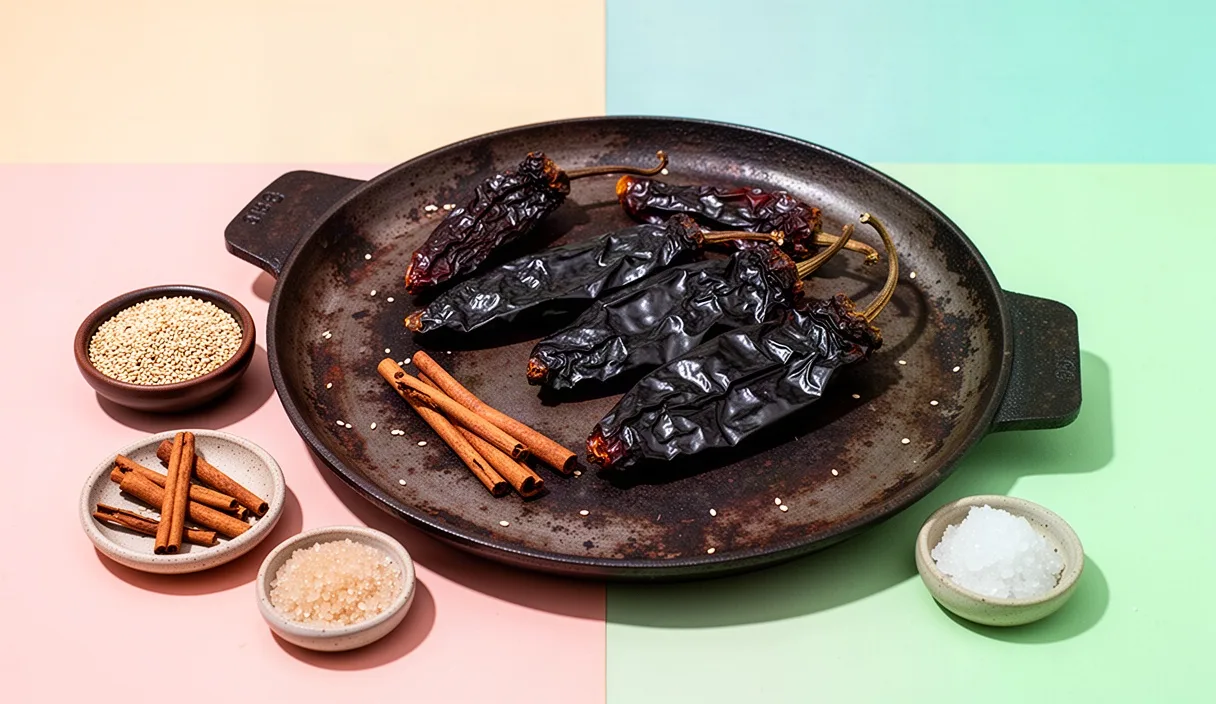
Heat your cast-iron skillet over medium-high heat until a drop of water skitters across the metal and disappears in two seconds. Work with the chile pods in batches so you do not crowd the surface. Press the pods down with a heavy spatula, toasting them until they blister and turn from dark red to a dull charcoal gray. Unlike moles such as coloradito, where skins must never blacken, mole negro requires the outer cuticle to crack and turn black across roughly two-thirds of its area. Turn them frequently; you want carbon, not white ash. Transfer the charred pods into a large heatproof bowl as each batch finishes.
Now comes the deliberate combustion of the reserved seeds. Turn your ventilation fan on its highest setting. Lower the skillet heat slightly, drop in the seeds and veins, and stir them constantly with a dry wooden spoon. Within moments, they will swell, pop, turn golden, then chocolate brown, and finally black. Once they start smoking heavily, tip the pan slightly toward the gas flame, or touch a long kitchen match to the surface of the seeds. The volatile oils will catch fire with a quiet hiss, creating small blue-and-yellow flames across the pan bottom. Let them burn for about fifteen seconds while stirring carefully to scorch them evenly, then immediately clap your metal lid over the pan to snuff out the fire. Allow the pan to cool for two minutes before lifting the lid.
The soaking and rinsing bath for bitterness removal
The single most common mistake made by home cooks attempting mole negro is taking these charred pods and burnt seeds directly to the blender. Unwashed carbon is purely alkaline and acrid; it tastes like lighter fluid and coats the mouth with dry grit. Oaxacan culinary tradition solves this chemical issue through a deliberate leaching process that strips the water-soluble bitter compounds while leaving the fat-soluble flavor compounds and insoluble black carbon pigments behind.
Transfer both the charred pods and the blackened seeds into a deep, non-reactive bowl made of ceramic or stainless steel. Pour boiling water over the mixture until the chiles are submerged by at least two inches. Weigh them down with a small heatproof plate to keep them from floating. Let the chiles sit in this initial steep for twenty minutes. The water will turn as dark as used motor oil, pulling out the bitter surface tannins and acrid pyrolytic chemicals that formed during the open burn.
- Drain the dark steeping liquid through a fine-mesh strainer into the sink, discarding the water completely.
- Fill the bowl again with cool tap water, gently massaging the softened chile skins with clean hands to dislodge loose, powdery ash particles.
- Let the chiles rest in the second cold water bath for ten minutes, then drain again through the strainer.
- Repeat the cold water rinse once more until the water draining away appears translucent amber rather than muddy black.
- Press the softened chiles gently against the mesh to remove excess water, then reserve them for grinding.
Taste a small scrap of the soaked chile skin. It should taste faintly smoky, raisin-sweet, and mild, with only a whisper of bitterness on the back of the palate. If it still produces an aggressive, sharp burn on your tongue, let the chiles soak in fresh cold water for an extra fifteen minutes before proceeding. This step makes the difference between an unpalatable, bitter stew and a rich, rounded mole.
Assembling the sweet and savory mole foundation
Mole negro achieves balance by contrasting the charred base with sweet elements, fried aromatics, warming spices, and thickeners. In your skillet, melt 60 grams of pure lard, or warm an equal amount of neutral avocado oil over medium heat. Fry one thick slice of stale sourdough bread or white bolillo until deep golden brown, followed by three plain corn tortillas until crisp. Next, fry half of a ripe plantain, sliced into rounds, until the edges caramelize to a mahogany glaze. Remove each ingredient as it finishes, setting them in a large mixing bowl.
In the remaining hot fat, brown one large white onion, sliced thick, along with eight peeled cloves of garlic and two medium plum tomatoes cut in halves. Cook until the tomatoes break down and the onion edges take on dark brown blisters. Add 40 grams of whole raw almonds and 30 grams of raw pumpkin seeds, toasting them until they color and emit a nutty aroma. Finally, toss in 25 grams of raisins, which will swell into round beads within forty seconds. Scrape this entire pan mixture into the bowl containing the fried bread, tortillas, and plantain.
Now address the spices, which must be gently bloomed in a dry pan without burning. Over low heat, toast four whole cloves, a three-inch stick of Mexican canela cinnamon, six whole allspice berries, half a teaspoon of black peppercorns, a teaspoon of dried Mexican oregano, and a teaspoon of coriander seeds. Grind these spices into a fine powder using a stone mortar or a dedicated spice grinder. Stir the ground spices into your wet bowl, then add 70 grams of coarsely chopped Oaxacan chocolate containing raw cane sugar and almond, or dark Mexican drinking chocolate with a coarse sugar crystal structure.
Processing the paste
Working in batches, combine the soaked chiles, the fried foundation mixture, and rich chicken or turkey stock in a high-speed blender. Blend for two full minutes per batch until you create an emulsion as smooth as silk. If your blender lacks a high-wattage motor, pass the resulting puree through a medium-mesh conical sieve, pushing the paste through with the back of a ladle to catch stray tomato seeds or tough chile skins.
Simmering the final paste without scorching pan corners
The cooking of the paste is where its texture transforms from raw pureed vegetables into an integrated, glossy mole. Choose a wide, heavy-bottomed Dutch oven or a traditional cazuela de barro. Heat three tablespoons of lard over medium flame until it shimmers. Pour the strained black paste into the fat in one continuous pour. The hot fat will crackle violently as the moisture hits it, a process traditional cooks refer to as frying the sauce, which sets the flavor and cooks out the raw taste of the alliums.
Once the initial spattering calms down, lower the heat to a gentle simmer. Add three cups of chicken stock, bringing the mole to the consistency of heavy cream. As the mole heats, starch from the fried tortillas and bread will begin to gelatinize, causing the sauce to thicken rapidly. The risk of scorching is high along the bottom edge where the pan base meets the vertical wall. Use a flat-edged wooden spatula, sometimes called a roux paddle, rather than a round spoon. Run the flat edge across the entire bottom of the pan every few minutes, tracing the inner corners methodically.
Simmer the sauce uncovered for 45 to 60 minutes. Keep the heat low enough that small bubbles burst lazily through the surface without spraying your stovetop. If the sauce thickens to the point where it resembles wet concrete, whisk in half a cup of warm stock to loosen it. Toward the end of the cooking time, taste and adjust the seasoning. Stir in a teaspoon of sea salt and, if the char still tastes slightly dominant, a tablespoon of grated piloncillo or dark brown sugar to round off the edges. The mole is done when a slick of tinted, red-black oil rises to the surface and coats the back of a spoon without separating.
Common mistakes
- Skipping the seed ignition: Omitting the burning of the chile seeds entirely results in an ordinary mole coloradito or mole rojo, leaving the sauce without the trademark pitch-black hue and deep, lingering finish of mole negro.
- Failing to rinse charred chiles: Dumping the chiles straight from the hot skillet into the blender without the hot and cold water washes creates an unpleasantly bitter sauce that tastes of wood smoke rather than complex, caramelized fruit.
- Using thin, high-heat cookware: Non-stick or lightweight aluminum pans warp under the temperatures required for charring, producing toxic fumes or burning holes straight through chile skins before the seeds roast thoroughly.
- Relying on baking chocolate: Standard European-style unsweetened baking chocolate lacks the coarse sugar, almonds, and canela typical of Mexican table chocolate, throwing off the sweetness balance.
- Abandoning the pot during the simmer: Because mole contains starches from bread and corn, leaving it unattended on medium heat for even five minutes can cause the bottom to catch, permanently tainting the entire batch with an unpalatable scorched flavor.
Practical next steps
Mole negro improves noticeably after a period of rest. Cool the cooked sauce to room temperature, transfer it to glass jars, and refrigerate it for at least 24 hours before serving. This rest period allows the distinct elements, such as the charred bitterness, sweet plantain, and pungent clove, to meld into a coherent, silky whole. The paste keeps in a cold refrigerator for ten days, or in a sealed freezer container for six months without degradation.
To serve, gently warm the mole in a wide pan, thinning it with a splash of fresh turkey broth until it flows like warm cream. Ladle it generously over poached chicken, braised pork shoulder, or warm corn tortillas rolled around shredded hen meat, finishing the plate with toasted white sesame seeds and thinly sliced raw white onion. If you find your kitchen space too tight or poorly ventilated for indoor charring, consider moving the dry-toasting and seed-ignition step outdoors to a portable gas ring or charcoal grill before bringing the softened, washed ingredients inside to finish your paste.