On a wet November morning in Nagano, the mountain air smells of damp pine needles and woodsmoke. Walk past the cedar walls of an old miso brewery along the Chikuma River, however, and the scent shifts entirely: warm toasted grain, sea salt, and the sweet, mushroom-like fragrance of active mold. For generations across the Japanese archipelago, these fermenting sheds have translated local geography into paste. Miso is not a uniform brown ingredient in a plastic tub; it is an archive of regional grain harvests, winter temperatures, and cellar microclimates that vary from the snowy valleys of Tohoku to the subtropical coasts of Kagoshima.
Every crock of miso relies on the same three foundational elements: cooked legumes, salt, and grain inoculated with the filamentous fungus Aspergillus oryzae, known locally as koji. Yet the final character swings wildly depending on what grain feeds the fungus, how much salt curbs wild bacteria, and how many summer heat waves the mixture endures in massive cedar vats. Understanding these variables turns miso from a generic seasoning into a precise culinary tool, capable of matching the delicate sweetness of spring vegetables or anchoring a heavy winter stew against an icy wind.
Decoding koji grains: rice, barley, and whole soybean origins
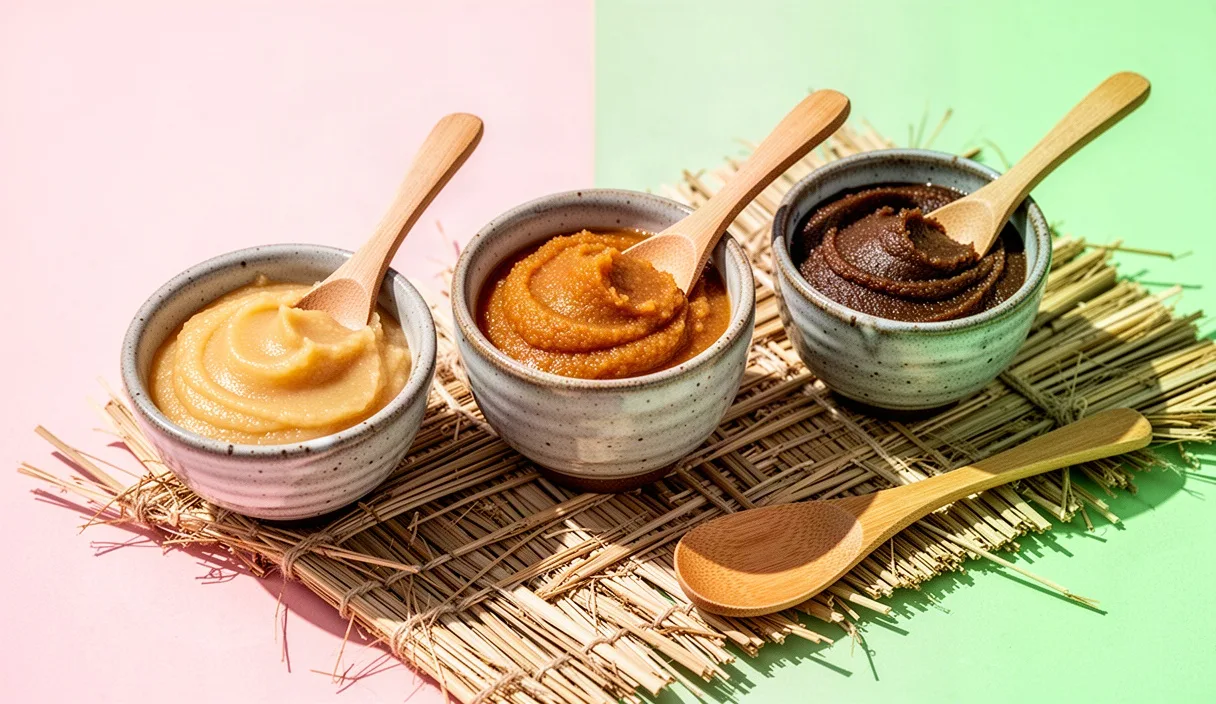
The culinary identity of any regional miso begins with the substrate used to propagate koji. While modern grocery shelves often collapse miso into simple color categories of red or white, Japanese makers categorize their craft by the inoculated grain. Across the country, three distinct families dominate domestic production: rice koji (kome miso), barley koji (mugi miso), and pure soybean koji (mame miso).
Rice miso accounts for roughly 78% of the country's output, blanketing the snowy northern prefectures down through the central mountains and into Kyoto. In cold inland basins like Nagano, historically known as Shinshu, pale yellow rice miso thrives. The mountain water is soft, and the harsh winters slow fermentation, producing a clean, moderately salty paste with balanced acidity. Further south, in the old imperial capital of Kyoto, rice miso takes an entirely different direction as Saikyo miso. Here, maltsters double the proportion of rice koji relative to soybeans and drop the salt content to roughly 5.2%. The ferment lasts only two to three weeks, yielding an ivory paste that tastes more like sweet almond cream than savory seasoning, built specifically to complement the subtle court cuisine of the Kansai region.
Turn toward the coastal farming communities of Kyushu, Shikoku, and the Seto Inland Sea, and barley miso takes center stage. Historically, coastal farmers reserved precious white rice for taxes or urban trade, turning their surplus winter barley into koji. Barley miso carries a rich, rustic aroma reminiscent of straw and toasted cereal, dotted with dark flecks from the grain hulls. Because barley contains less starch than polished rice, it produces a less cloying sweetness and a distinct, savory earthiness. Salt levels in traditional southern mugi miso hover around 9.4% to 10.8%, making it assertive enough to stand up to the oily fish pulled from the surrounding waters.
The rarest and most intense expression comes from Aichi prefecture in central Japan: mame miso, famously produced around Okazaki under the name Hatcho miso. Here, makers bypass grain koji entirely. Cooked soybeans are shaped into large, dense balls called tamakoji, inoculated directly with mold spores, and packed into towering cedar casks with roughly 11.6% salt. Workers stack tons of river stones atop the vats in earthquake-proof pyramids. The paste ages through at least two full summers and two freezing winters, emerging as a dense, dark-brown, nearly chocolate-hued brick with tobacco, mineral, and tamarind notes, backed by a firm, pleasant bitterness.
| Style | Koji Substrate | Regional Heartland | Typical Aging Time | Approximate Salt |
|---|---|---|---|---|
| Shiro / Saikyo | White Rice | Kyoto, Kansai | 2 to 4 weeks | 4.8% to 5.8% |
| Shinshu | White Rice | Nagano, Central Alps | 4 to 12 months | 11.2% to 12.4% |
| Mugi | Barley | Kyushu, Seto Inland Sea | 3 to 8 months | 9.2% to 10.8% |
| Hatcho (Mame) | Soybean only | Aichi Prefecture | 24 to 36 months | 11.4% to 12.8% |
Matching pale spring ferments with dark winter pastes
Traditional Japanese cooking aligns seasoning with the ambient weather outside the kitchen window. Light, short-aged pastes belong naturally to early warmth, while dense, multi-year ferments serve the darkest weeks of winter. When April brings damp chills and the first green shoots, pale rice miso mirrors the season. Its high sugar content, derived from unfermented rice starches, pairs cleanly with sweet spring cabbage, tender young bamboo shoots, and small littoral clams. The high salinity of winter paste would overwhelm these delicate ingredients, masking their mineral sweetness.
As the year turns toward December and winds whip through drafty wooden houses, cooking shifts toward dark pastes. Red miso from Sendai or stone-pressed Hatcho miso contain high levels of melanoidins, the complex savory compounds produced by extended Maillard browning during long fermentation. These robust pastes hold up against fatty meats, root vegetables, and thick broths. A pot of tonjiru (pork and vegetable soup) loaded with burdock root, taro, and daikon requires the deep savory bassline of aged red or barley miso to balance the rendering pork fat. A pale Saikyo miso in that same pot would taste thin, sugary, and oddly cloying.
Home cooks across Japan rarely limit themselves to a single tub, routinely practicing awase miso, the art of blending two or three varieties in a single meal. A dependable everyday ratio for brisk weather combines roughly 64% pale Shinshu rice miso for brightness and aroma with 36% aged Hatcho or red miso for body and persistence. By adjusting the proportions, you can tune a soup to match the exact temperature of the evening, lightening the blend during a mid-autumn warm spell or deepening the shade when frost hits the garden.
The ladle and chopsticks method for clean dissolution
The fastest way to ruin a delicate dashi broth is to drop a solid lump of miso directly into the saucepan. Miso contains cooked legume solids, coagulated proteins, and grain fibers that will not dissolve passively in hot water. Dropped straight off a spoon, the lump sinks to the bottom, scorches against the stainless steel, and breaks apart into unappealing, chalky curds while leaving the surrounding liquid watery and unseasoned.
Professional kitchens rely on a specialized conical wire strainer called a misokoshi, but domestic cooks achieve the same precision using only a metal ladle and a pair of long cooking chopsticks (saibashi). This method allows you to emulsify the paste gently into the broth, controlling the texture and inspecting the sediment before it integrates into the pot.
- Ladle Broth: Lower your soup ladle into the simmering broth until it fills roughly two-thirds full with hot liquid. Lift the ladle slightly so the rim sits just above the liquid surface, keeping the broth inside the ladle warm without losing it to the pot.
- Portion Paste: Pick up your measured miso paste, usually about 18 grams per 180 milliliters of dashi, using the tips of your chopsticks. Submerge the paste directly into the broth captured within the ladle bowl.
- Whisk and Emulsify: Hold the ladle steady with your non-dominant hand. Use the chopsticks to work the paste against the curved bottom and sides of the ladle in small, rapid circles. The trapped hot liquid will gradually break down the paste, creating a dense, velvety slurry inside the spoon.
- Strain Coarse Husks: Once the paste is fully suspended with no hard lumps remaining, slowly tilt the ladle to let the emulsified liquid flow into the main pot. If you are cooking with rustic barley miso, whole barley hulls will remain in the bottom of the ladle; you can discard these fibers if you prefer a silkier mouthfeel, or tip them in for a rustic country texture.
Why active ferments degrade under rolling boils
One rule governs every traditional soup kitchen in Japan: miso must never boil. The ideal moment for introducing paste is at the very end of cooking, a stage known colloquially as nie-bana, or "the flower of the boil." This is the precise instant when the broth shivers and tiny bubbles gather at the edges of the pot, roughly 82 to 85 degrees Celsius, just before a full rolling boil breaks the surface.
The restriction is rooted in organic chemistry. Miso contains a complex spectrum of volatile aromatic compounds, including higher alcohols, esters, and organic acids generated by yeast and koji during months in the wood vats. When broth hits a rolling boil of 100 degrees Celsius, these volatile aromatics evaporate rapidly into the kitchen steam. Boil a miso soup for even 90 seconds, and its nuanced aroma vanishes, leaving behind an aggressive, flatly salty liquor with a sharp, slightly bitter finish.
Furthermore, traditional miso is a living food teeming with beneficial enzymes, primarily proteases and amylases, alongside wild lactic acid bacteria. While anyone seeking specific therapeutic outcomes should consult a qualified nutritionist or medical professional, food scientists recognize that high heat rapidly denatures these proteins and inactivates microflora above 65 degrees Celsius. By turning the stove off completely before dissolving the paste, you preserve both the live enzymatic integrity and the delicate volatile aromatics that define an artisanal ferment.
Preserving living miso pastes in domestic refrigerators
Because traditional miso contains between 5% and 13% salt, it will not spoil into a toxic state under ordinary kitchen conditions. Pathogenic bacteria cannot easily colonize an environment with such low water activity. However, miso is chemically unstable when exposed to ambient warmth and oxygen. Left in a warm pantry, it continues to ferment aggressively, generating gas that can swell containers, darkening in color, and developing harsh, oxidized flavors through ongoing Maillard reactions.
To keep an artisanal paste tasting like the day it left the brewery, domestic refrigeration is essential. Temperatures between 2 and 4 degrees Celsius slow enzymatic reactions down to a crawl, maintaining the original balance of sweetness and acidity. Once you open a container, moisture management becomes the main challenge. Condensation dripping off a plastic lid onto the surface of the paste can dilute local salt concentrations, creating pockets where surface molds might establish themselves.
- Surface barrier: Smooth the surface of the paste completely flat with the back of a spoon. Press a square of parchment paper or clear plastic wrap directly onto the paste, smoothing out any trapped air bubbles before securing the outer lid.
- Edge cleanliness: Wipe the inner walls and rim of the container with a clean, dry paper towel after every use to prevent dried crusts from forming.
- Freezer storage: If you keep multiple regional tubs on hand, store long-term reserves in the home freezer. Because of its high dissolved salt and solute content, miso does not freeze solid at standard freezer temperatures of -18 degrees Celsius. It remains pliable and scoopable straight from the cold drawer without suffering ice crystal damage to its texture.
Common mistakes
The most frequent error in preparing regional miso is treating every variety with an identical hand. Using the same volume of deep Aichi bean miso as you would delicate Kyoto white miso will result in an unpalatably harsh, astringent broth. Always taste the raw paste from the tip of a chopstick before cooking to judge its salt concentration and adjust your dashi volume accordingly.
Another regular misstep is adding miso too early alongside raw ingredients. Root vegetables, squash, and proteins should be cooked through in unsalted dashi or water until completely tender before the paste enters the pan. Salt firms vegetable cell walls and toughens meat fibers, preventing them from softening properly during cooking. Keep the miso out of the pot until the final two minutes of preparation.
Finally, avoid dumping out the small layer of dark amber liquid that occasionally pools on the surface of long-aged misos. This liquid, historically known as tamari, is concentrated umami rich in amino acids that seeped out during fermentation. Stir it directly back into the paste to keep the tub moist and balanced.
Next steps for the home pantry
To build an expressive, versatile miso foundation in your own kitchen, bypass the generic paste tubs and select two contrasting regional jars from a dedicated Japanese grocer. Choose one pale, short-fermented rice miso, such as a Kansai-style Saikyo, and one dark, long-aged variety, such as a traditional Shinshu red or an Aichi Hatcho.
Before making a single pot of soup, conduct a direct water tasting. Dissolve half a teaspoon of each paste into separate bowls containing 60 milliliters of warm, unseasoned water at 80 degrees Celsius. Do not use dashi for this test. Taste them side by side. Notice how the pale ferment leads with grain sugar and soft fruit notes, while the dark ferment coats the palate with iron, earth, and savory depth. Once you understand the unvarnished voice of each paste, you can blend them purposefully, matching the seasonal produce on your cutting board to the living traditions of the Japanese countryside.