Morning light at the Mercato Testaccio catches the damp crates long before the bulk of the neighborhood wakes up. By seven, the vegetable vendors have stacked their wooden bins with wet, jagged greens cut from the fields of the Roman Campagna. Spring in the city does not announce itself with gentle pastels; it arrives through astringent sap, rough stems, and the deep, resinous bite of the extended chicory family. For cooks standing over apartment stoves between Trastevere and Monteverde, this season demands a specific literacy of bitter plants, one learned by watching the vendors trim back dark foliage to expose pale, juicy cores.
Working with these greens requires an understanding of how bitterness functions in the pan and on the palate. Bitter compounds, predominantly sesquiterpene lactones, protect the plant from pests in open soil and provide the assertive spine that defines Roman cooking. Rather than masking this bite with excessive dairy or sugar, local domestic kitchens rely on sharp knife work, ice baths, good olive oil from the Sabine hills, and salted fish. Navigating the market crates without confusing table varieties for braising varieties is the first discipline every home cook must master before lighting the burner.
Differentiating chicory cultivars at the greenmarket stall
The bins at any Roman market stall display half a dozen cultivars that casual visitors often lump together as wild dandelion or simple chicory. In local practice, each botanical selection has a dedicated purpose, kitchen treatment, and cooking window. The most ubiquitous crate holds cicoria catalogna, characterized by long, saw-toothed green leaves wrapped around hollow, ribbed stalks. When these plants are allowed to head up into tight clusters of hollow internal spears, they become cicoria di catalogna spigata, the source of puntarelle. Buying the whole head means obtaining two distinct culinary ingredients: the tough, dark outer foliage destined for boiling and sautéing, and the crisp, hollow inner shoots reserved for the mortar and pestle.
Beside the catalogna, vendors arrange lower heaps of cicoria di campo, often sold as erba amara or misticanza di campo. These are smaller, ground-hugging rosettes with hairy stems and thin leaves harvested from fallow fields or cultivated systematically in open ground. They hold a markedly higher concentration of bitter milky sap than forced or greenhouse greens. Nearby sit bunches of radicchio variegato and cultivated dandelion leaves, along with strascinati varieties whose broad midribs will turn meltingly tender under long exposure to low heat.
Selecting the right head requires tactile inspection rather than relying solely on visual color. Look for cut bases that remain moist and pale ivory; a dark brown or split stem indicates the green has spent forty-eight hours or more in dry transit. Stalks should snap cleanly under lateral thumb pressure rather than bend like rubber. If the outer leaves are limp, the internal shoots have already lost the turgor pressure needed to curl properly in the prep bowl.
| Market Name | Botanical Form | Primary Kitchen Use | Texture Profile |
|---|---|---|---|
| Cicoria Catalogna | Tall, jagged leaves with thick midribs | Braising, boiling, pan-tossing | Fibrous, firm, persistent chew |
| Puntarelle (Spigata) | Hollow, compact internal floral shoots | Raw salad preparation | Brittle, juicy, hollow crunch |
| Cicoria di Campo | Low ground rosettes, thin stems | Quick blanching, oil dressing | Tender-chewy, highly astringent |
| Cima di Rapa Tardiva | Leafy brassica with small florets | Direct stovetop stewing | Mineral, peppery, yielding |
Trimming and curling tender puntarelle centers
Breaking down a head of catalogna spigata begins with separating the coarse outer leaves from the hidden core. Grasp the root base firmly with one hand and strip the long, dark peripheral leaves outward and downward. Do not discard these stems; reserve them in a basin of cool water for the evening braise. As you strip the leaves away, you reveal the cluster of swollen, pale-green shoots resembling a cluster of small asparagus tips huddled around the center core. Snap or cut these shoots from the central base individually.
Each shoot is hollow and conical. In traditional Roman households, cooks employ a small wooden tool strung with cross-hatched wire, known as a tagliapuntarelle, to shred the stems into thin ribbons. If you work with a standard kitchen knife, select a short paring knife with a sharp, thin blade. Place the shoot flat against the cutting board. Trim away any tiny leafy tufts from the tip, then slice the hollow stalk lengthwise into halves. From there, slice each half lengthwise into strips no wider than two to three millimeters.
The precision of this knife cut directly governs the physical curl of the vegetable. Because the exterior skin of the shoot contains denser vascular fibers than the tender interior wall, the physical release of tension causes the strip to curve back on itself when hydrated. Cuts made too thick remain rigid and resist dressing, while ribbons cut too thin collapse into mush once exposed to vinegar and salt.
- Strip the outer dark green leaves down to the root crown and store them separately.
- Snap each hollow inner shoot cleanly from the root base using your fingers or a paring knife.
- Halve each shoot lengthwise, exposing the hollow interior channel.
- Cut each half into thin, continuous ribbons measuring two to three millimeters in width.
- Transfer the cut ribbons immediately to a clean basin without applying salt or pressure.
The cold water soak for texture and bite reduction
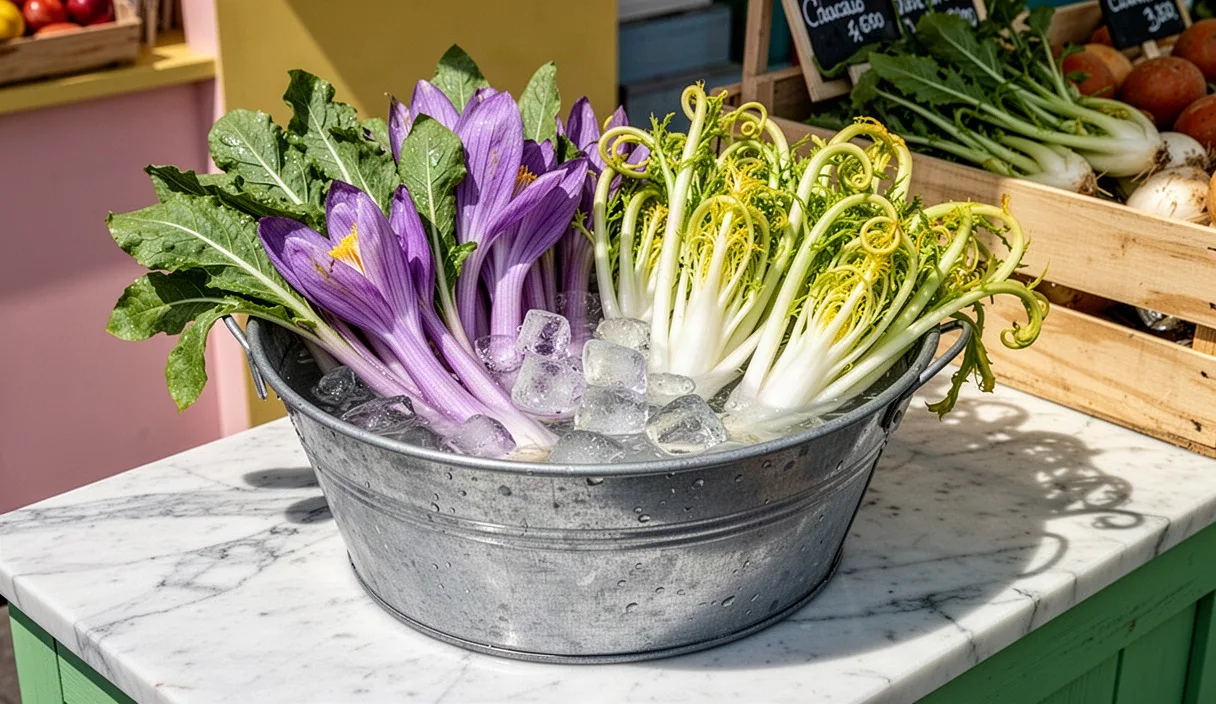
Immediately after cutting, the ribbons must be transferred into an ice water bath. This step is not merely decorative; it initiates a profound physical change in the vegetable tissue. As the cells take up water through osmosis, the differing expansion rates between the cut inner tissue and the waxy epidermal layer force the ribbons into tight, spring-like spirals. At the same time, the bath leaches out a controlled portion of the bitter sap released by the ruptured cells.
Fill a deep ceramic or stainless steel bowl with cold tap water and drop in at least a dozen ice cubes. Submerge the sliced puntarelle completely. The ribbons should steep in this cold environment for a minimum of forty-five minutes, though sixty to ninety minutes produces the tightest, crispest curls. Keep the bowl in the coldest part of your kitchen or in the refrigerator during this rest period. If left on a warm counter near the stove, the ice will melt too rapidly, the water will warm up, and the shoots will remain limp instead of snapping crisp.
Drainage requires equal care. Bitter ribbons saturated with surface water will dilute your dressing, causing the oil and vinegar to slide off into the bottom of the salad bowl. Lift the curled greens out of the ice bath using your hands or a skimmer, leaving any fine dirt or sand at the bottom of the bowl. Spin the curls thoroughly in a manual salad spinner, working in small batches to avoid crushing the delicate loops, then spread them across a clean linen tea towel to dry for ten minutes before assembling the dish.
Slow stovetop braising with garlic and olive oil
While the tender centers curl in ice, the dark, fibrous leaves set aside earlier require heat, oil, and patience. In Rome, this preparation is simply called cicoria ripassata: chicory that has been boiled first and then passed back through the skillet with fat and aromatics. Raw catalogna leaves dropped directly into an oil pan turn leathery and scorch before their fibrous midribs soften. Boiling softens the cellular wall and extracts the most aggressive resinous notes into the water.
Bring a wide, deep pot of unsalted water to a rapid rolling boil. Plunge the thoroughly washed outer greens into the water, pressing them down with a wooden paddle. Boil them uncovered for eight to twelve minutes. Check the thickest part of the white midrib; it should yield readily to the tip of a paring knife without disintegrating. Drain the greens thoroughly in a colander and let them cool until they can be handled safely. Squeeze the boiled greens between your hands with firm, deliberate pressure to expel as much trapped water as possible, forming tight, compact clumps. Coarsely chop these clumps across the grain into four-centimeter lengths.
For the pan work, select a heavy carbon steel or cast iron skillet. Pour in extra virgin olive oil to coat the bottom generously, roughly four tablespoons for half a kilogram of boiled greens. Add two whole cloves of garlic, peeled and gently crushed with the flat of a knife, along with a dried red pepper split in half. Warm the pan over low heat until the garlic begins to sizzle gently, releasing its fragrance into the oil without taking on any brown color. If the garlic burns, the oil turns acrid and ruins the greens.
- Drop the chopped, squeezed greens into the warm, infused oil, listening for a steady, low sizzle.
- Scatter half a teaspoon of coarse sea salt over the greens to help draw remaining moisture.
- Turn the greens repeatedly using wooden tongs, untangling the clumps so the seasoned oil coats every leaf.
- Lower the heat and let the greens cook uncovered for fifteen to twenty minutes, stirring every three minutes.
- Allow the bottom layer of greens to catch slightly against the pan surface to develop a savory crust, then fold it back into the mass before turning off the heat.
Tossing raw bitter shoots with warm anchovy vinaigrette
The definitive Roman preparation for crisp, curled puntarelle relies on an emulsion driven by salt-packed anchovies, raw garlic, and red wine vinegar. The salt and oil tame the raw bitterness of the shoots, while the acidity cuts through the oily richness of the fish. Avoid oil-packed anchovy fillets sold in jars when possible; their texture is often mushy and their cure lacks the mineral edge of whole fish preserved under salt.
Prepare the anchovies by scraping away the heavy salt crust under a gentle stream of cold water. Lift the fillet away from the central backbone with your thumb, discard the spine, and pat the fillets thoroughly dry on paper towels. For a generous bowl of salad serving four people, use four whole salted anchovies (yielding eight single fillets) and one small clove of fresh garlic. If the garlic clove displays a pale green sprout in its center, split it open and pry the germ out, as this raw sprout creates an unpleasantly sharp aftertaste.
The emulsion must be constructed in a rough stone or ceramic mortar rather than an electric food processor. Mash the garlic clove against a pinch of coarse sea salt until it reduces to a translucent, wet paste. Add the drained anchovy fillets one at a time, grinding them in a circular motion against the rough wall of the mortar until they disintegrate completely into the garlic base. Slowly dribble in two tablespoons of sharp red wine vinegar, stirring with the pestle to dissolve the paste into a brown, fragrant slurry.
Once the paste is completely smooth, whisk in five to six tablespoons of robust, peppery extra virgin olive oil in a steady stream until the mixture forms a loose, opaque emulsion. Just before serving, place the thoroughly dried, ice-curled puntarelle into a wide terracotta or wooden bowl. Pour the dressing over the greens and toss vigorously with your hands, massaging the sauce into the hollow curls so that every crevice catches the salty dressing. Let the dressed salad stand at room temperature for five minutes before serving; this brief rest allows the vinegar to soften the shoots just enough to release their cold, refreshing juices.
Common mistakes
- Skipping the squeeze step on boiled greens: Tossing wet boiled catalogna straight into the skillet results in greasy, boiled soup rather than caramelized, oil-infused greens. Always press out the water with your palms until the leaves are damp rather than dripping.
- Cutting puntarelle strips too wide: Wide strips will not curl in the ice bath. They remain flat, stiff planks that reject the emulsion and overpower the mouth with tough fibers. Keep your cuts under three millimeters.
- Allowing garlic to brown during the braise: Chicory already carries high levels of bitter compounds. Browned or charred garlic introduces a burnt, acrid quality that clashes destructively with the natural vegetable bitterness.
- Dressing the curled shoots too early: Once tossed with vinegar and salt, the curled shoots begin to weep water and lose their cellular crispness within twenty minutes. Apply the dressing no more than five to ten minutes before eating.
- Using unrinsed or soggy salad curls: Water clinging to the exterior of the shoots prevents the oil-based anchovy dressing from adhering, causing the sauce to slide to the bottom of the bowl and leaving the top greens bland and watery.
Practical next steps for the kitchen
To begin working with Roman greens this week, visit an early morning produce market or a well-stocked greenmarket stall and ask specifically for whole heads of untrimmed cicoria catalogna spigata. Ensure you have heavy sea salt, unrefined red wine vinegar, and whole salt-packed anchovies in your pantry before starting. Clean your kitchen workspace thoroughly, clear space in your refrigerator for a wide ice bath, and sharpen your paring knife to a razor edge.
If you have specific gastrointestinal sensitivities or dietary restrictions related to high-fiber diets or sodium intake, consult a qualified healthcare professional or dietitian regarding the consumption of concentrated bitter greens and cured fish products. Otherwise, approach these seasonal vegetables as a dual task: dedicate the hollow, pale cores to the lunch salad bowl, and reserve the hearty, boiled leaves for a slow, garlic-scented evening pan.